Finding similar accessions
The Similarity Search function helps you explore potential duplicate accessions on Genesys. It is particularly useful for curators and researchers who want to check whether incoming material might already exist in their collection or in other genebanks.
Why similarity search matters
Before adding new samples to their collection, curators usually check their records to see if the material was previously accessioned from another source. They typically do this by comparing the passport data of the incoming material against all existing records in their database.
DOIs can reliably and unambiguously identify a specific sample, which helps with this process. The GLIS DOI Portal scans the internet for connections between DOI-enabled PGR and can correctly link accessions held in different genebanks. However, DOI adoption for PGRFA remains optional, so only a subset of conserved and managed crop diversity can be linked in this way using fully automated tools. Even accessions that do have a DOI often do not link back to the material from which they were sourced, because those DOIs were not known at the time of acquisition.
From 2007 to 2010, CGIAR genebanks developed eight Crop Registries as part of the Global Public Goods Project Phase 2 (GPG2). The goal was to recover missing information about accessions of crops held in common among the centres, to both complete centre-own databases and identify which samples are unique and which are duplicates of samples held in different genebanks.
What all these tools share is that some form of data standardization and validation is applied before data analysis takes place. Genesys has already handled this preliminary, time-consuming step by enforcing strong standardization rules. Now Genesys also performs the matching analysis itself.
How to start a similarity search
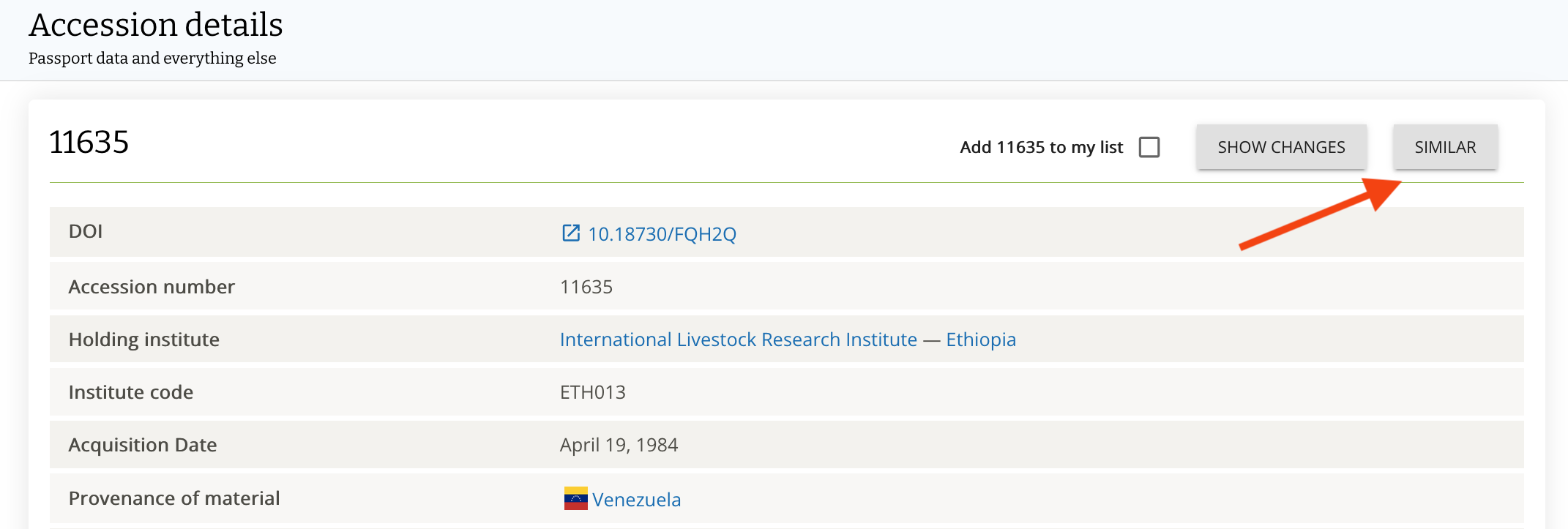
The search for similar accessions is available to registered users. You can start one from the accession details page by clicking the Find similar button.
Understanding the results
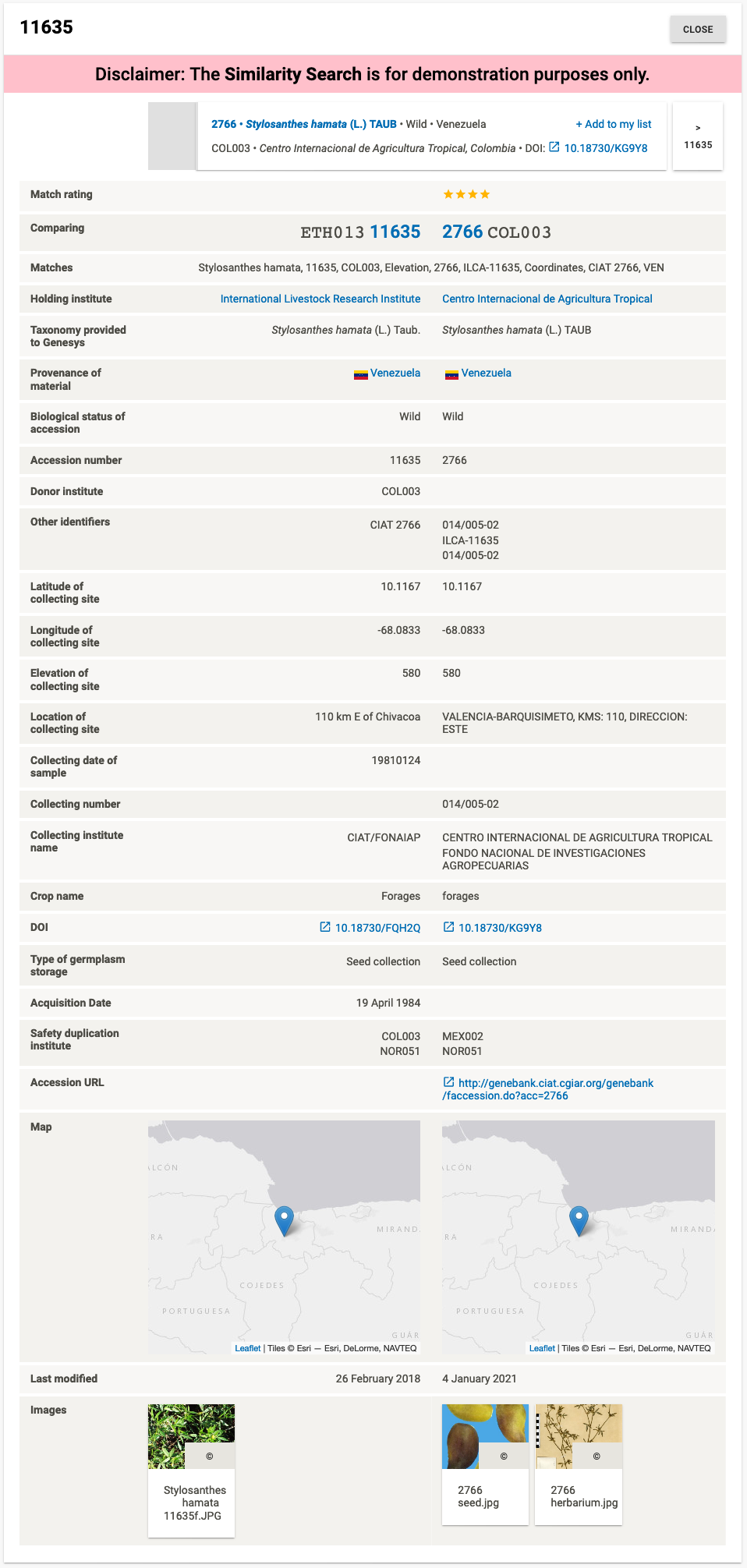
Genesys scans the entire database of 4,000,000+ records and returns a limited number of matches, with the best matches first. The candidate is displayed side-by-side with the selected accession so you can evaluate the result.
Navigating results
The results bar shows the currently selected match in the middle, with buttons to navigate to the next and previous matches.

Genesys contains over 250,000 records of germplasm with standardized and coded passport data ready for comparison.
Recording your evaluations
It helps to record the results of each expert evaluation, so you do not need to re-evaluate the same pair of accessions again in the future.
The GLIS DOI Portal allows genebanks to permanently record the relationships of an accession to other material with a DOI. For material without a DOI, however, there is no reliable mechanism yet. Exact information about replication of material will become possible when all PGRFA in genebanks adopt DOIs.
How does Genesys do it?
To find accessions with similar passport data to a selected accession, Genesys uses the following approach:
-
Standardized values: The passport data of candidate accessions are compared using their standardized or coded values.
-
Free-text matching: For free-text fields like description of collecting site, a combination of both the Sørensen-Dice coefficient and the Levenshtein distance is used.
-
Alias matching: The points arising from the field-by-field comparisons are added to the score of each unique name and other number (aliases) of the accession.
-
Similarity rating: After scoring all candidates, the 20 highest scoring candidates are taken and given a similarity rating.
-
Score capping: When the score of the best candidate is very high, all other good candidates end up with a low ranking. To help ensure good candidates remain visible, Genesys caps the maximum advantage of the top-ranked candidate at approximately 80%.